Dearest Friends,
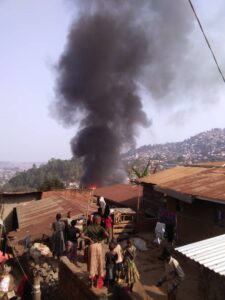
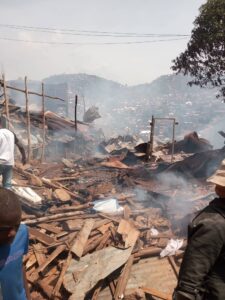
First of all, a big thank you to all of you for your support, which has allowed us not only to continue the activities we’ve already started—despite the enormous difficulties the region is facing—but also to launch new small-scale projects to help meet, even just a little more, the immense needs of the people of Mwenga, Kamituga, and also Bukavu, where there has been a significant increase in the number of internally displaced persons due to the war, unemployed people, street children, children who don’t go to school, and so on. During my last trip to Bukavu a few months ago, I was astonished to see crowds of children of all ages on the streets, who tried their best to sell anything they could, when they weren't begging or wandering the streets. In recent months, on an almost weekly basis, several working-class neighborhoods in Bukavu have been devastated by fires; in one such fire, in September, A school also caught fire, causing the death of at least 20 children. All of this is due to overcrowding, makeshift shelters made of wood and plastic sheeting, illegal and unregulated connections to the power grid, etc…
The projects in Bukavu will be the focus of an upcoming newsletter; in this one, I’d like to focus on the activities currently underway in Mwenga.
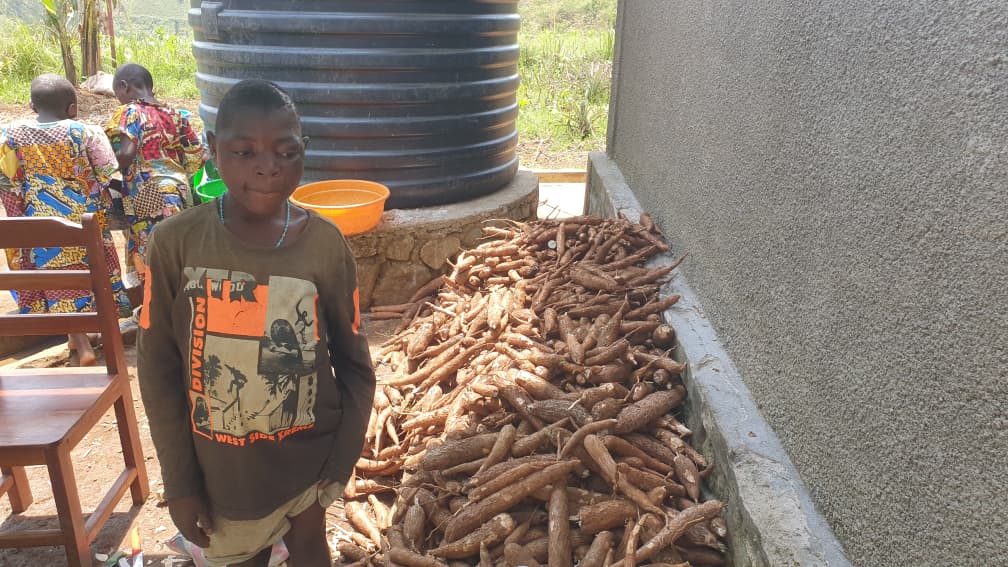
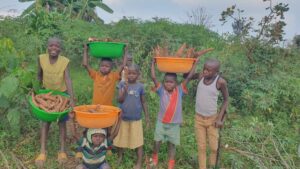
Finally, some good news. After nearly 12 months, we harvested the cassava! The children, together with our workers, harvested it with great joy.
.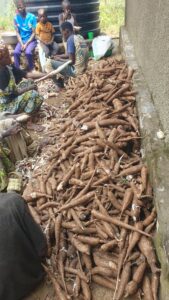
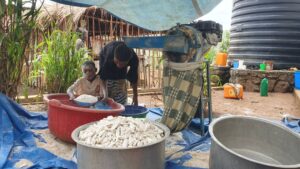
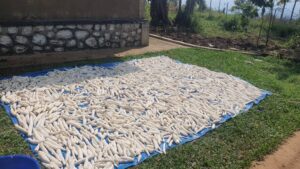
And this despite the fact that the field where we had planted our crops—a field we had rented and worked hard to cultivate, often in heavy rain or under the blinding sun—had been partially occupied by Burundian soldiers, who had set up their base camp there. Thanks to the tireless negotiations of our diligent Angelo, we tried to salvage as much as possible and limit the damage: thus, our hard work and patience were rewarded, and we harvested a bountiful crop of cassava! I recall that this extraordinary and hardy plant not only provides, through its roots, the staple food of the local population (its flour is used to makeugali or fufu, a sort of hard polenta used as bread), but also provides, throughout the year, numerous highly nutritious and flavorful leaves, once pounded and cooked for a long time over the fire with palm oil and peanut flour (sombe). Once harvested and peeled, the cassava must be left to ferment in water for several days, then slowly dried in special wood-fired drying ovens, and finally ground (we bought a special mill). All of this has been done, and our small food storage has been stocked with about 200 kg of cassava (we consume about 100 kg a month!), and we haven’t even finished harvesting yet—we might end up with 500–600 kg!
We'll still have to harvest from the second field in a few months.
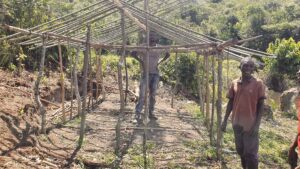
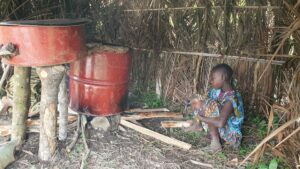
Activities also continue around the fish farm pond, where there’s always maintenance work to be done and where we’ve built a small facility to produce corn wine, so we can feed the fish with the byproducts and earn some money from the sales to pay for the various necessary tasks. The children have also collected cassava peels and brought them to the pond to feed the fish—nothing goes to waste!
The children have gone back to school; three of the oldest have been promoted to middle school as the top students in the school! We had an unexpected visit from Christian. You may remember that rambunctious little boy who fell two years ago and broke his leg badly; I was the one who took him to Bukavu for surgery—an exhausting journey in an overcrowded minibus with a suffering child who couldn’t walk. A few months later, once he had regained full mobility, we couldn’t keep him settled, and he returned to Kamituga, to the streets where he had come from. After briefly trying to make a life for himself in Bukavu (where we tried in vain to integrate him into our carpentry workshop), he returned to Mwenga, to Maison Msaada, asking for forgiveness and saying he was ready to go back to school. Perhaps he was frightened by the M23 soldiers who, as he was traveling from Bukavu to Mwenga, They tried to kill him, he said. Unfortunately, once again, it wasn't possible to keep him there; the lure of the street and freedom was still too strong, and after a few weeks he left the center.
The girls attending the sewing classes are making good progress; they’ve taken their midterm exam and will finish the course early next year. We were able to sell some of the uniforms they made before school started. The girls who already completed the course at the beginning of this year come regularly to use our sewing machines once a week, and we’re thinking of giving them one or two machines (which we’d have to buy in Bukavu) so they can continue their work independently and start a small cooperative. 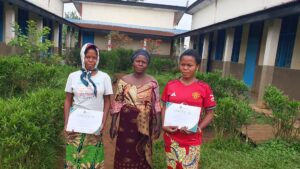

The number of children and adolescents (now including some adults) with epilepsy in the community we serve and treat continues to grow (they are the ones who come to us), and some of them have been enrolled in a literacy course aimed primarily at adult women, which is set to begin shortly. Most of them are seizure-free and have returned to school or resumed working.
We would also like to launch a small local crafts workshop for seniors and people with disabilities. These are two small projects that should get underway by the end of the year.
At the end of July, we launched another small project aimed at supporting small businesses run by widows or abandoned women who have many children to support and face significant difficulties paying school fees. It was a long and arduous selection process (everyone there is poor!), but we finally managed to recruit 10 women in Mwenga and 10 in Kamituga (the latter thanks to the efforts of Dr. Darock—I remind you, the president of our local association, who currently runs the Kamituga hospital).
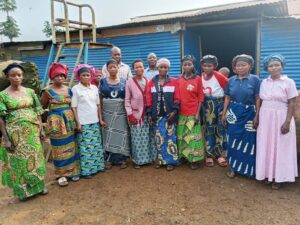
We check in with the women every week; many of them need advice and help to keep their small businesses running. We also check in on their children to make sure they’re attending school. Unfortunately, one of these women died tragically a few days ago, buried by a mound of earth that collapsed on her while she was collecting sand near the river to sell. This is certainly not an activity we encourage, but it is a way for the women in Mwenga—who are accustomed to carrying loads of up to 50 kg—to earn enough to feed their large families. She had 11 children to support (7 of her own and 4 belonging to a brother who had already passed away). Perhaps we will have to take in one or two of them at Maison Msaada. Unfortunately, similar accidents are common in the region, especially in the mines.
You might be wondering: what about the war? Is it still going on? Unfortunately, nothing has changed. The front line remains around Kasika, about twenty kilometers from Mwenga. Every now and then you hear gunfire; the two sides clash, and trucks get stuck for days. Mwenga is still a military camp, occupied by the Wazalendo, the FARDC, and Burundian forces. Abuses—especially against women and young girls—are a daily occurrence… and my return there still doesn’t seem possible, but I’m planning a trip to Bukavu, which I’ll tell you about in my next letter!
Warm regards to everyone, and once again, a huge THANK YOU from all of our children as well!


